Digital-asset transfers introduce wallet, network and price risks. A casino’s claim that it accepts cryptocurrency is not proof that the gambling service is licensed for the reader’s location.
Digital-asset transfers introduce wallet, network and price risks. A casino’s claim that it accepts cryptocurrency is not proof that the gambling service is licensed for the reader’s location.
Key facts and verification checklist
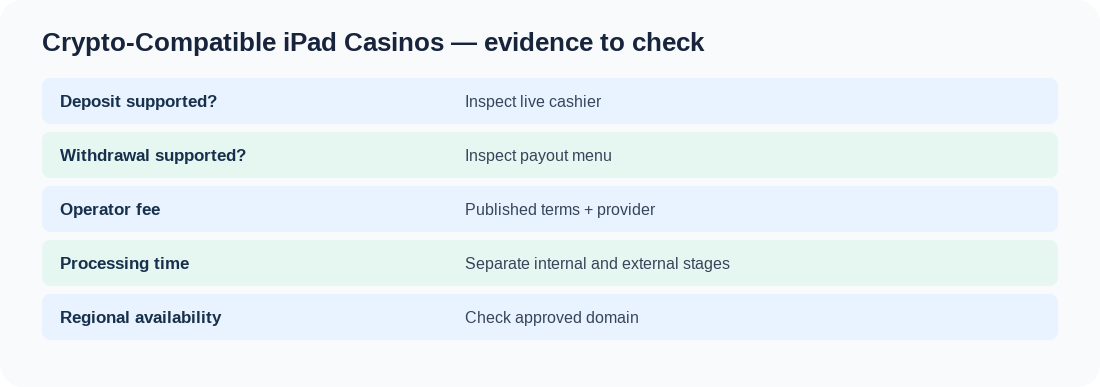
Use the following checks before treating any casino entry, payment method or product statement as current. An absent observation is not evidence of a failed feature.
| Field | Deposit | Withdrawal |
|---|---|---|
| Method appears in cashier | Verify | Verify independently |
| Minimum and maximum | Record currency + amount | Record currency + amount |
| Provider or operator fee | Record source | Record source |
| Estimated timing | Operator’s published stage | Bank / wallet delivery stage |
| Identity verification | May apply | May apply |
Where crypto casino payments may be allowed
The live cashier is the strongest operator-level evidence for digital assets support. Confirm the casino is licensed where the user is located, log into the relevant account if permitted, and record whether digital assets appears for deposits, withdrawals or both. Avoid extrapolating from a payment provider’s general merchant support.
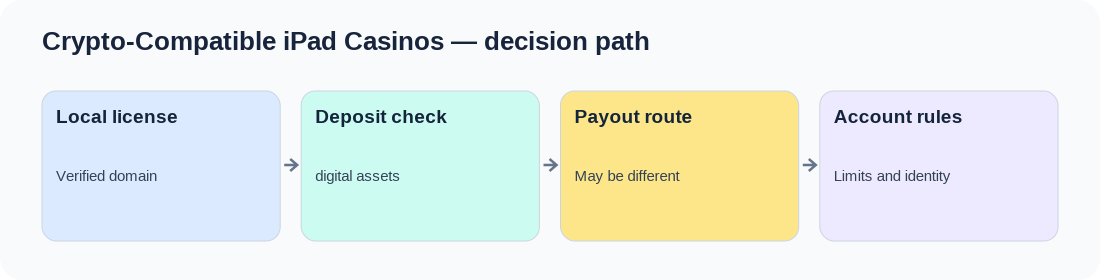
The comparison table should link every accepted-method claim to the observation date. A blank field means not checked, not unsupported; a rejected method should include the operator explanation if one exists. Payment-provider branding on a marketing page is weaker evidence than a current cashier flow.
Licensing and jurisdiction checks
Use the official jurisdiction-specific register. Match the brand, underlying legal entity and internet-casino permission to the exact domain; record the public source URL and date. Do not assume a license in one place applies in another.
Compare documented crypto support
The live cashier is the strongest operator-level evidence for digital assets support. Confirm the casino is licensed where the user is located, log into the relevant account if permitted, and record whether digital assets appears for deposits, withdrawals or both. Avoid extrapolating from a payment provider’s general merchant support.
The comparison table should link every accepted-method claim to the observation date. A blank field means not checked, not unsupported; a rejected method should include the operator explanation if one exists. Payment-provider branding on a marketing page is weaker evidence than a current cashier flow.
Currencies and deposit/withdrawal differences
The cashier is the primary source for account-specific availability; the public terms explain limits and exceptions. Record deposits and withdrawals separately, and identify any pending verification before stating a timetable.
Payment and custody risks
Digital assets availability is not universal across regulated markets. Where legal status is uncertain, do not list an operator until a local authority and the casino’s own terms confirm it.
Digital-asset transfers are often irreversible, network charges may change and exchange-rate movement creates additional loss risk. A wallet address must be checked independently. Account verification and payment-name matching protect both the operator and the account holder.
Volatility, fees and irreversible transfers
The cashier is the primary source for account-specific availability; the public terms explain limits and exceptions. Record deposits and withdrawals separately, and identify any pending verification before stating a timetable.
Practical distinctions
| Feature | What readers should check |
|---|---|
| Legal status | Do not list cryptocurrency as a valid casino payment method until the local regulatory framework and operator policy support it. |
| Irreversibility | Transfers sent to the wrong network or address may be unrecoverable. |
| Price change | Exchange-rate movement can change the effective cost between sending and receiving. |
| Custody | Check whether a player controls the wallet or uses a third-party custodian and how verification is handled. |
- Record the jurisdiction and eligible casino domain.
- Capture the exact terms or a first-hand iPad test log.
- State how recently the evidence was collected.
- Remove estimates or rankings with no reproducible basis.
Verification standards and safer-play safeguards
Digital assets availability is not universal across regulated markets. Where legal status is uncertain, do not list an operator until a local authority and the casino’s own terms confirm it.
Digital-asset transfers are often irreversible, network charges may change and exchange-rate movement creates additional loss risk. A wallet address must be checked independently. Account verification and payment-name matching protect both the operator and the account holder.
Frequently asked questions
Can digital assets be used for both deposits and withdrawals?
Not necessarily. Check the live casino cashier and payout menu separately.
Are digital assets transactions instant?
No universal speed applies. Internal processing and the receiving provider’s delivery are separate stages.
Does payment availability prove a casino is licensed?
No. Verify the exact casino domain in the local regulator’s records first.
Sources and verification
Official registers establish regulatory listings at their publication or access date. They do not independently demonstrate live payment support, current game counts or actual device performance.
Gambling involves a risk of financial loss. Only adults who meet local age and location requirements may use regulated casino services. If gambling is causing harm, consult specialist support or your local regulator.